Friday, August 11, 2017

What to do with Farmers' Market Cipollini


So you've spent three or four or five bucks on a wee bunch of donut-shaped little Italian onions.  There's no shortage of recipes for them: baked, fried, glazed (think Ottolenghi), but these invariably require a bowlful of onions.  And who wants to spend $20 or more just for one recipe's-worth of onions?


Here's an idea that takes just a few perfect local jewels of allia, and through the magic of Italian simplicity and devotion to the very best ingredients, makes a thoroughly elegant and satisfying dinner for two in half an hour.


In addition to the onions, you'll need good quality pasta.  You want the artisanal, bronze-die, imported stuff.  I get mine at Marshalls / Home Goods for a song.  Mass-produced pasta, even Barilla, is dried at a higher temperature---that's why it's a darker color---that affects flavor and nutrition, and the smooth surface makes the sauce less apt to stick.  This is especially important for lighter, more fluid sauces like this one.

I'm a fan of Parmigiano Reggiano, although I want to point out that IT IS NOT the "Undisputed King of Cheeses," an opinion that is easily and obviously demolished by simple disputation.  But for pasta I almost always use grated pecorino cheese.  The flavor is more forte.

An assertive herb note is important here, and I went with sage from my big pot of herbs out back.  Rosemary, or a combination if the two, is also a good choice.  A sprinkling of parsley won't cut it.

This is easy-peezy.  But get the onions cooking in advance.  Remember the motto is The Sauce Waits for the Pasta!

For Two:

200g high quality spaghetti
4-6 cipollini
3 tbsp. chopped fresh sage
1/3 cup grated pecorino Romano
extra virgin olive oil
sale and pepper

Put a big pot of salted water on to boil and heat the oven to 425 degrees.

Trim the cipollini but keep the stems intact.  Cut them into wedges: quarters for small ones, Sixths for bigger ones.  Any bits that separate during cutting can be cooked in a skillet for a few minutes to soften.

Toss wedges to coat with a bit of olive oil and salt and roast in a pan on parchment paper until soft and slightly charred at the edges.  It should take 15 minutes or so but keep an eye on them. 

When the onions are done, start the pasta.

Put a sauté pan on medium heat, add a few tablespoons oil, and cook any of the separated onion pieces to soften, then add the sage and cook for a minute. Then transfer the onions from the oven to the pan and turn the heat to low

By now the pasta will be almost done.  Cook it for a minute less than the package says.  Ladle a half cup +/- of cooking water into the pan and stir the ingredients well.  Ladle another half cup into a bowl just in case and drain the pasta.

Add the drained pasta to the sauce, turn up the heat, and add the cheese gradually while tossing.  Add the reserved water if necessary to reach a creamy consistency.  Taste for salt and pepper and serve on warm plates.  Drizzle with more oil if desired

Wine?  This works with just about any Italian wine, red or white.  We drank a nebbiolo.


Monday, June 26, 2017

Science Experiment: Grapes and Bread

People who think beer pre-dates wine are numbskulls.  Beer takes effort, technology, and a recipe.  Wine, like shit, happens; all by itself.  How?  Because that white bloom you see on grape skins is actually wild yeast. 


So thinking back to the marvelous chapter Adam Real Last Name Unknown from Kitchen Confidential and it's descriptions of the degenerate baker's lexan tubs full of various dough starters  ("feed the bitch") I said to myself, self, let's see if we can make bread with flour, water and grapes.  I didn't even add salt to give the yeasts the best possible fighting chance.


I'd like to be able to say that I carefully measured everything, but like many other things I'd like to say, such as Jennifer Aniston just did my manscaping, I can't.  But this should come close and is more of a general guide.  I also saved a bit of the starter and now have my own wee bitch in a jar in my fridge, so we'll see how long I can keep it alive.


Put approximately 1 1/2 cups of AP flour in a bowl big enough to allow expansion and add UNWASHED grapes.  I used five big seedless black grapes, but you can use smaller ones I guess and just add more.  I also cut a slit in each one to let out a little juice to help the fermentation.  And here's a tip, leaving the stems on will help with extraction later.  Stir well with 1 cup of water, or more as needed; it should be rather liquid. cover with plastic wrap and let the magic happen.  It may take several hours.  Once the fermentation gets going you can stir in more and more flour until you have something like bread dough.  Once you have a nice rising dough you can do the punching down, kneading, etc.  I suggest a day or two of cold fermentation in the fridge, too.


WARNING: It's not going to have that sour, boozy smell like s. cerevisiae, but will instead seem rather . . . funky.  Don't worry and start imagining all the vile critters growing in your starter.  The oven kills everything anyway.


When ready to bake, fish out the grapes and stems (I used tweezers), make a nice round loaf and let it rise on cloth---I recommend the super peel---covered with another cloth.  Note that this dough will spread as much as it rises, it's that kinda dough.  I baked mine on a pizza stone at 450 degrees using the Julia Child water spay method: apply dough to stone, spray water on the stone, then again after two  minutes, then again after another five.  I took it off the stone and transferred it to a rack after another ten minutes so the bottom doesn't get too burned, and it cooked for another ten minutes, so say 25-30 minutes all day.  You want an internal temp of 200 degrees.  I really recommend this method.  The stone gives great oven spring and the steam keeps the crust from forming before the bread has really risen.


The crust was nice and the crumb had a very interesting texture.  It was soft and nicely colored with a few large vertical air holes in the dome.  I served it with homemade goat cheese ricotta and olive oil.  Yum.


Try it!

Wednesday, June 21, 2017

Felafel Fail, your oil's too hot

One of the nuptial burdens I've learned to live with is that my wife's appetite for variety meats is the barest fraction of mine.  So while I can sometimes sneak in some lengua tacos or chicken liver pate, I have to wait for her to be out of town to enjoy tripe, kidneys, tendon or other nasty bits.  But it was a surprise to learn that she's no fan of falafel either.  None of this diminishes my affection and commitment, but it does limit my practice sessions with this deceptively simple preparation. 


One thing I have learned over time is that success is not so much about the recipe but the technique.  No great epiphany, I suppose, since that's almost always the case.  But instead of obsessing over dried fava vs dried ceci, cilantro to parsley to mint to whatever ratios, or whether or not to use scallions, onions or both, I have focused on the actual frying. 


After numerous batches of charred, bocce-worthy falafel balls, I have come to the conclusion that when it comes to falafel frying temperature, lower is better.  Incidentally, this is a concept I've been warming to (pun intended) for some time.  From Robuchon's seminal cold-start frites to a growing availability of science-based information: the old saw about "high temp good, low temp greasy" is getting shopworn.  Furthermore, unlike breading, batters or just raw protein, things like herbs and spices and alliums---the stuff that falafels is made of---can just plain BURN in hot oil.  So forget the 350-375 degree world of overdone, bitter---and yes, possibly greasier---falafel.  Be like Fonzie, and cool it down to 300-325 degrees for the best results.

Friday, July 26, 2013

Hungry for Himalayan: Ema Datshi

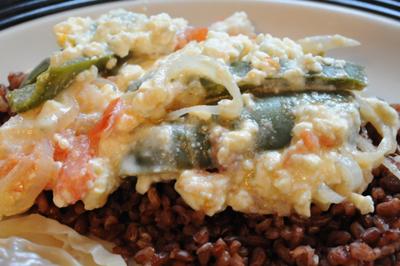
So after watching Lewis Black's skewering of that dumbass Rick Perry and its reference to Bhutanese cuisine, I did a little web searching and found that there was a pretty much undisputed national dish called Ema Datshi.  You can find quite a few Google images around, but this one pretty much captures what I made


The dish is tasty, easy, vegetarian if you are so disposed, and can be made with easy to find ingredients save one, Bhutanese red rice (and yak cheese, but no one is REALLY going to try and buy yak cheese, right?).  But if you happen to have access to a store that caters to hippies, like I do, it shouldn't be hard to get.  The recipe could not be simpler.

For Two People

3 green banana peppers
3 long hot peppers (if you use orange or red ones, the heat levels will be color-coded!)
1 large onion
1 large ripe tomato
5 garlic cloves
4 tbsp. of butter
6 ounces of cheese.  I used Queso Cremita but use what you like, melty or not
1 rice cooker cup of Bhutanese red rice

Make the rice according to your rice cooker's directions.  Or use 1 part rice to 1 1/2 part water on the stove.

Grate the cheese coarsely.  Slice the peppers thickly lengthwise and remove seeds.  French the onion, coarsely chop the tomato and peel and lightly crush the garlic cloves. 

Put the peppers, onion, tomato, garlic and butter into a heavy pan and add water just below the top of the vegetables.  Bring to a boil and cook until the vegetables begin to soften, stirring occasionally, about 5 minutes.

Add the cheese and stir to melt/combine it with the other ingredients.  Cook until it's the consistency you like and serve on the rice.  Easy-peasy-Bhutanesey!

Wednesday, February 20, 2013

A French Approach to Scottish birds


I recently ordered some game birds from D'Artagnan.  A Scottish Wood Pigeon and a Red-Legged Partridge . . . shotgun pellets and all!

They were delivered overnight and reasonably priced considering they had been fluttering about in the heather not too long before!

I found a wonderful recipe for partridge from the classic and weighty tome Paul Bocuse's French Cooking: Perdrix á la mode d'Isigny.   Isigny is a town in Normandy And as this region is famous for its apples and its dairy products, you can bet that a recipe d'Isigny will feature one or both of these ingredients.  Incidentally, I read that the origin of Walt Disney's family name is "d'Isigny."

Simple, and delicious.  You may want to use a fancy stovetop and oven proof casserole for this, but you don't need a cover so any small, fairly deep pan that will hold the bird with just a bit of space left around it will do. 

Get a fairly thick slice of panchetta and tie it over the bird's breast while trussing.  The round shape of the panchetta will make it fit the breast just right, and being unsmoked  it won't mask the bird's own flavor.  Note that while I DO NOT recommend trussing chickens or other larger birds, it's fine here because it assists even browning and because the legs are so small they don't cover much of the breast.  The panchetta shield, officially known as barding, will keep the breast from drying out but is a temporary measure.  Don't worry about perfect trussing technique.  Just make sure the legs are pulled together and the pachetta is secure.

Now brown the bird in butter all over for a total of about 10 minutes.  Naturally you'll want to use high quality butter, or even the real deal, but watch your temperature or the butter will burn!

The bird will not be fully cooked at this point, but set it aside to rest, pour off any excess butter and deglaze the pan with white wine, vermouth, or even better . . . Calvados!  Reserve the juices and put the pan back on the heat.

Peel, core and cut into thick slices 2 firm, medium sweet apples.  Add more butter to the pan and lightly brown the apple slices but DO NOT cook them all the way through.  Do them in batches so as not to crowd the pan OR you can brown them in a larger pan while you brown the bird.

While this is happening . . . or when done, remove the trussing and barding from the bird.  You will make your life easier by taking the now cooled bird and using a stout knife cutting it almost in two down the center of the breast.  This way, when it's cooked and hot and saucy, you can easily split it in half for two.  If you're eating alone, you can skip this step.

Once the apple slices are browned, line the bottom of the casserole with a layer and put the bird on top, breast up.  Nestle the remaining slices all around the bird, leaving the breast exposed.  Make sure that they hold the two halves of the bird together.  Add the reserved deglazing juices and pour half a cup (or more) of crème fraîche over all so that it coats the bird.  Pop all into a 350 degree oven, uncovered.  Cook until the bird is done medium rare, not more than 130 degrees in the breast and the sauce is bubbly.  You can even give it a shot of the broiler to add some browning if you take care not to overcook the meat. GAME BIRDS ARE SERVED RARE . . . PERIOD.

The classic accompaniment to upland game is Bourdeaux or some robust, dry red wine.  And that did go very well with the Wood Pigeon with peas (recipe so other time).  But for this I would go with a Pinot Noir or even "a nice Chianti").  Ith gu leòir!

P.S.  What do you do with the left over panchetta?  How about serving it in an egg sandiwch on an English muffin, Monsieur Dumas?

Sunday, June 17, 2012

Poule au Pot Feu de Camp Lyonnaise

Another camping trip this spring led me, the wife and our close friends Candace and Steven to Cowans Gap State Park which straddles the line between Franklin and Fulton Counties in south central Pennsylvania.  Lovely country out there, but you can forget this place if you camp in tents.  Apparently the DCNR thinks site maintenance consists of dumping another load of gravel on the pad every year.  Consequently it took me an hour just to get the tent stakes in, and I had to dig down to the Devonian layer in order to do it.  And nothing feels quite as nice in a tent than sharp stones rippling through the nylon floor.


While in the area, I recommend a visit to the Mountain House Bar and Grill on Route 30 near the top of "Big Mountain."  Because the bar also straddles the county line and half of it lies in  a "dry" township, they only serve beer.  But based on the look of the clientele, this might be for the best.

A fun spot to check out is Mercersburg, south of the park.  It's got a charming main street with B&Bs, bars and restaurants with fairly sophisticated menus that cater to the crowd visiting nearby Whitetail ski resort.  Oh, and three of R.E. Lee's sesech cavalry had a bit of a bad day there during the Gettysburg campaign.

But on to the food . . .

This recipe really requires our footed dutch oven with the rimmed lid.  You still have yours, right?

For four people you'll want six to eight chicken thighs (around three pounds) with skin on.  A two or three pound bag of yellow onions and an equal weight of waxy potatoes like Yukon Gold make up the vegetable portion.  You'll also want a couple of cans of chicken broth, or beef if you want more intense meaty flavor, or water if you're packing light.  Get you some woodsy herbs, too.  I used sage, thyme and rosemary that were about to die in my crisper.  FYI, parsley won't do much in this recipe except as a garnish.  Its flavor will be overwhelmed by the long cooking and the VINEGAR.   That's right, you'll need to bring a wee jar of vinegar, that's what makes this Lyonnaise.  Salt and pepper of course, and some kind of fat: oil, lard, etc are it for the ingredients.

Start a fire of hardwood charcoal, or just plain wood.  Enough to burn for an hour or so.

French the onions.  That means slice in half through the root, peel, lay flat and slice into crescent moon shaped slices lengthwise.  You can do this ahead, of course.  Then cut the spuds into nice sized chunks, skin on. Bigger is better than smaller, here.  Tie up your herbs, stems and all, into a bundle (un bouquet garni, en français). Season the chicken well with salt BUT NOT pepper, yet.  Pepper burns.

Spread out the charcoal and get your dutch oven in there to heat.  Add fat, and then the chicken, skin side down, to brown a bit.  You don't need to brown it too much because there will be more browning later . . . you'll see.  Turn and brown the other side, then remove to the lid and keep warm (and fly-free) near the fire.  Pop in the onions and cook until translucent and starting to brown.  Add the spuds and herbs and NOW the pepper, then stir to combine.  Pour in enough broth or water to just cover the vegetables. When it comes up to the boil, return the chicken thighs, skin side up, in one layer, covering the onions and potatoes.  Put the lid back on and add plenty of hot coals to the lid.   Now let the magic happen.  The veggies and meat will get moist heat from below while the skin will brown under the dry heat of the lid.  Check after about 30 minutes to make sure the tops aren't burning, but don't keep lifting the lid every five minutes.  Remember "if you're lookin, it ain't cookin." When the thighs are a delightful mahogany color and the potatoes yield to a blade it's ready, but if you take the coals off of the lid, this can simmer for a while.

To serve it forth, plate the chicken.  Dig out and discard the herb bundle.  Stir a tablespoon of vinegar, or more to taste, into the vegetables and serve them on the side.  We enjoyed ours with ice cold Peroni, and it was as delicious as l'abbraccio di una bella donna.  The late spring woodland sunset didn't hurt.


Monday, May 30, 2011

There Ain't No Place I'd Rather Be


We visited Tennessee with our friends Candace and Steven at the end of April. Part of a pilgrimage to various Civil War battlefields over the next four years' sesquicentennial. Well, actually, that's MY effort. I had wanted to visit Shiloh since as long as I could remember. The wife and friends just wanted to see Tennessee, Memphis, Nashville, etc. The trip included a visit to Steven's Tennessee relatives, and it was also a bit of a food pilgrimage to places like Gus's Fried Chicken. but more on that later.


We rented an RV from Martin RV in Lititz, PA. Well, actually it's closer to Brickerville on the 28th Division Highway but they have a Lititz mailing address. Word to the wise, if you live within 50 miles and are looking to rent an RV, call them and get a quote when you shop around, because they were cordial, flexible and up to HALF the cost of other places that quoted us. And there no nickel and dime charges for everything. We picked up our 31 foot C Class on Good Friday afternoon, loaded it with essential marching rations (chips, beer and booze), and headed west on the PA turnpike, then south on 81 along the old Valley Turnpike through the Shenandoah.


There are a lot of ideas about the etymology of "Shenandoah," but my favorite is "Daughter of the Stars." Although there were no stars that first night, because it rained and rained all the way to Staunton, Virginia. That first night we slept in the parking lot of a Welcome Center. The idling diesel engines and the occasional shriek of air brakes did little to keep this weary traveller awake and considering it was free . . .